

Here's the part that too often gets left out: $109,000 is the maximum, not the default. It only applies to someone who was at least 18 years old in 2009, has been a Canadian tax resident every year since, and has never put a dollar into a TFSA. If any of those three things isn't true for you, your number is smaller — sometimes dramatically smaller.
How TFSA room actually accumulates
TFSA contribution room is earned one year at a time. You accumulate that year's dollar limit for every calendar year in which you are both:
- Age 18 or older, and
- A resident of Canada for tax purposes.
Miss either condition in a given year, and that year's room simply never existed for you. There's no catch-up mechanism for the years before you qualified — the clock starts when you start, not in 2009.
The good news: partial years count in full. There is no proration. Turn 18 on December 31? You get the entire year's limit. Land in Canada as a new resident in November? Same thing — the full annual amount for that year is yours.
Younger Canadians: your room depends on your birth year
If you were born in 1991 or earlier, the full $109,000 applies (assuming continuous Canadian residency). For everyone younger, room begins accumulating in the year you turned 18. Find your birth year in the chart below — the bar beside it is your 2026 total.
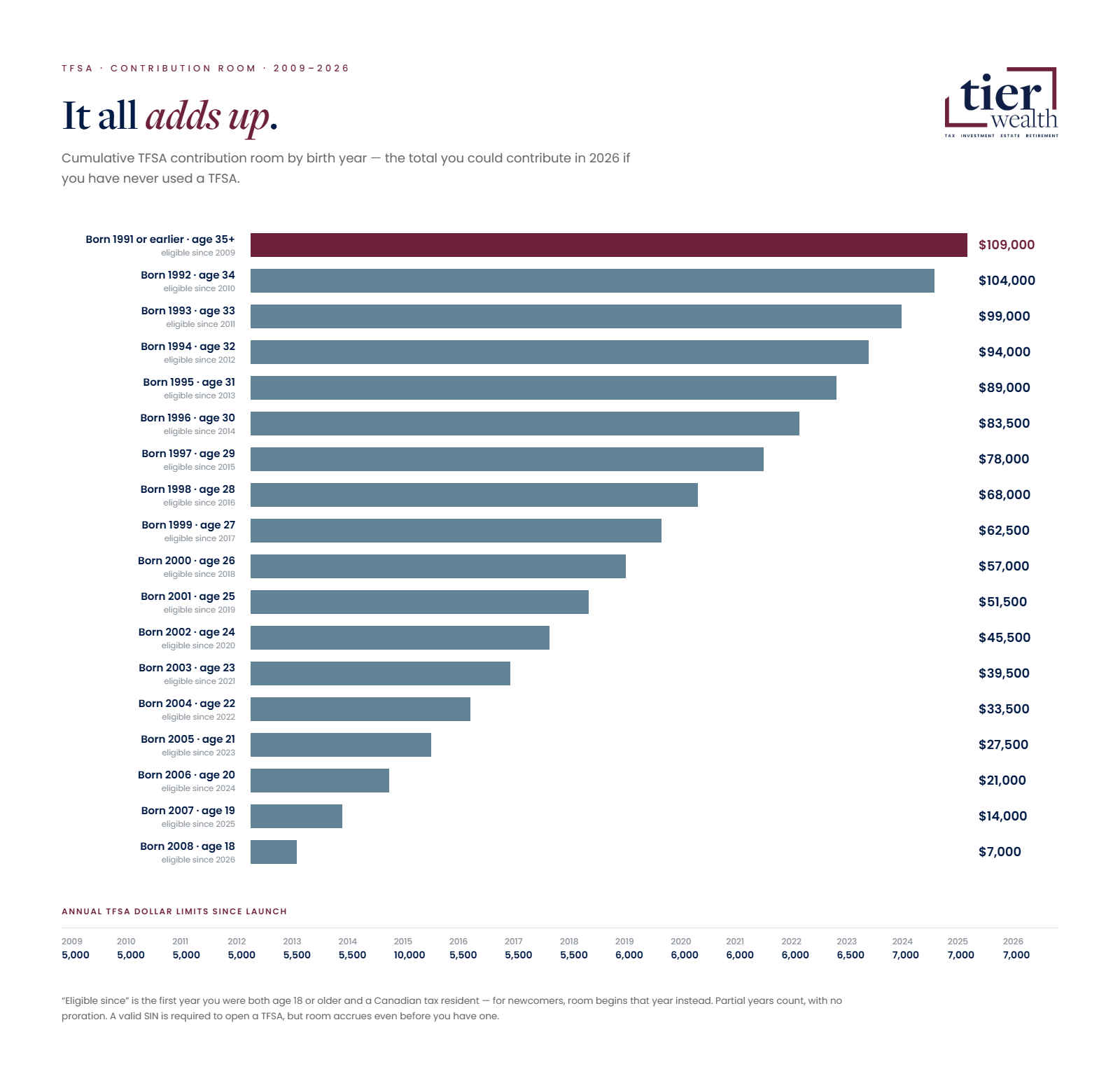
That bottom bar deserves a warm welcome: if you were born in 2008, 2026 is your very first year of room. Welcome to the club.
One provincial wrinkle worth knowing: contribution room accrues federally at age 18, but you can't actually open a TFSA until you reach the age of majority in your province or territory. Here's where the line falls:
If you're in the second column, an 18-year-old accumulates a full year of room they can't yet use — which means a 19-year-old in Vancouver opens their first TFSA with two years of room ready to go. Nothing is lost; it's simply waiting. Alberta readers: no gap, carry on.
Newcomers to Canada: your room starts when your residency does
This is where the most expensive mistakes happen.
If you were born in 1994 and became a Canadian tax resident in 2016, your TFSA room did not start in 2009 — and not when you turned 18 in 2012, either. It started in 2016, the first year you were both a tax resident and at least 18; whichever milestone comes later is the one that governs. That's the highlighted cell in the matrix below: $68,000 of cumulative room as of 2026, not $109,000.
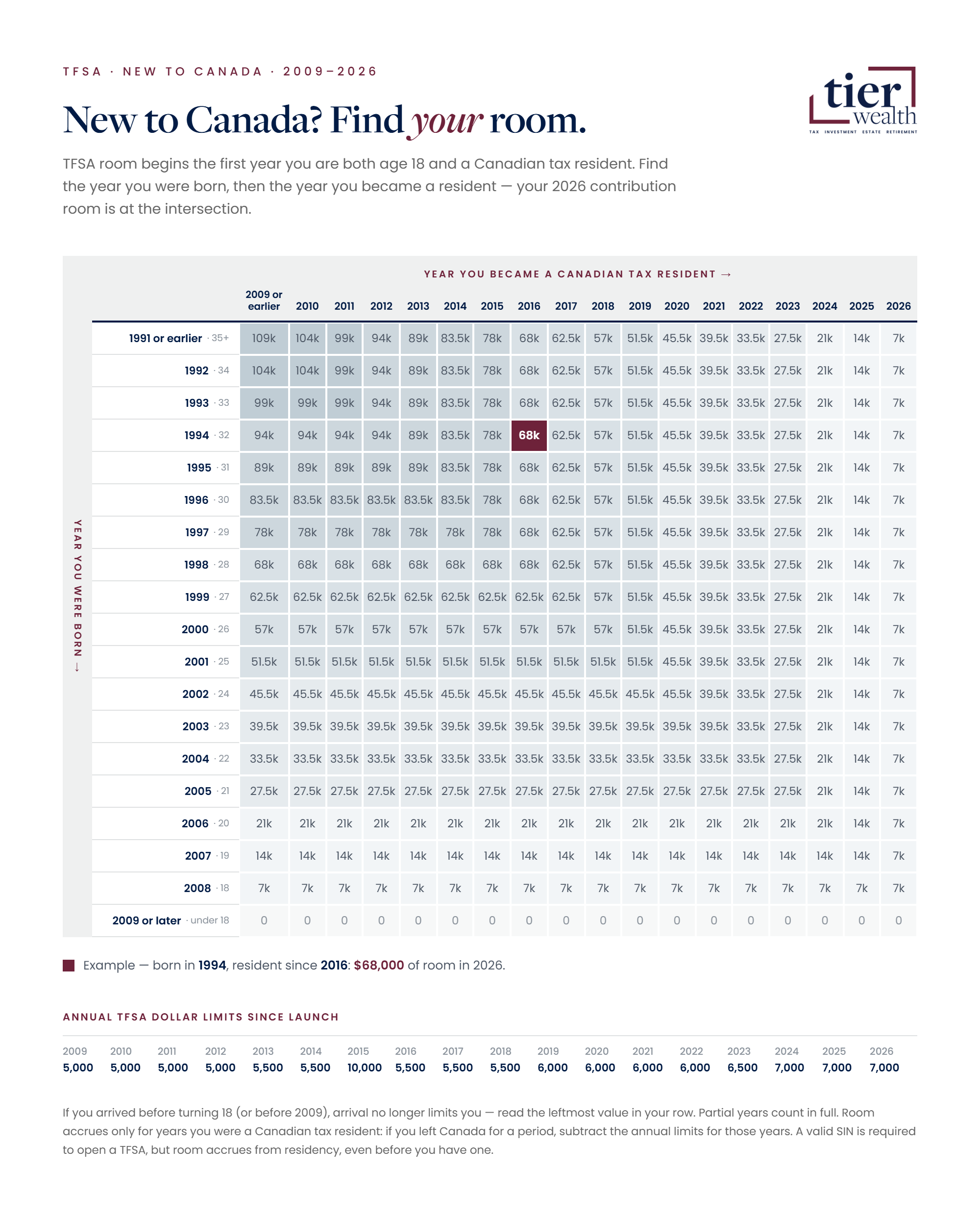
Contributing based on the headline number when your actual room is half that triggers the TFSA over-contribution penalty — and it compounds quickly.
Two more traps for globally mobile clients. First, years of non-residency don't count — if you left Canada for a few years and came back, the years you were away generated no room. Second, contributing while non-resident is its own penalty: any contribution made during a period of non-residency attracts a separate 1% per month tax, regardless of how much room you have.
And a common misconception in the other direction: you don't need to have had a SIN, filed a tax return, or opened an account for room to accrue. If you were 18 or older and resident, the room accumulated whether you knew about it or not. Plenty of 30-year-olds who've never opened a TFSA are sitting on $60,000-plus of untouched room.
Already have a TFSA? Here's how the math works
Once you've been contributing for a while, your available room stops being a number you can read off a chart. It becomes a running total with three moving parts: the room you've never used, the withdrawals waiting to come back, and the new limit each January. The formula for any given year is: unused room from prior years + withdrawals made last year + the new annual limit.
Let's make that concrete. Meet Liam, born in 2000 — eligible since 2018, so the chart above gives him $50,000 of cumulative room through the end of 2025. Over the years he's contributed $45,000 of it. In mid-2025 he withdrew $10,000 to help buy a car. What can he contribute in 2026?
Notice what the timing did there. Through the back half of 2025, Liam's available room was only $5,000 — the withdrawal changed nothing until the calendar flipped. If he'd had second thoughts and re-deposited the $10,000 in December 2025, he would have been $5,000 over his limit and into 1%-per-month penalty territory. The identical deposit made in January 2026 is entirely penalty-free. Same money, same account — a few weeks apart, completely different tax result.
Don't blindly trust CRA My Account (especially early in the new year)
CRA's "TFSA contribution room" figure is only as current as the data behind it — and there's a structural lag built into how that data arrives. CRA doesn't see your TFSA activity in real time. It relies on financial institutions to report every contribution and withdrawal after the year ends, on the TFSA annual information return — which isn't due until the last day of February: the 28th, or the 29th in a leap year (and the next business day when that lands on a weekend). Until those returns are filed and processed, CRA simply doesn't have the information to update the number it shows you.
The practical result: check My Account in January or February and the figure typically reflects nothing you did in the prior year. Liam's mid-2025 withdrawal, for example, won't reach CRA until his bank files in early 2026 — so the room showing on his screen in January will be missing it, along with any deposits he made during 2025. Every year, people over-contribute because they treated that stale figure as gospel.
The reliable approach: keep your own running ledger of contributions and withdrawals, and remember that withdrawals only restore room on January 1 of the following year — not immediately.
Prefer the full ledger?
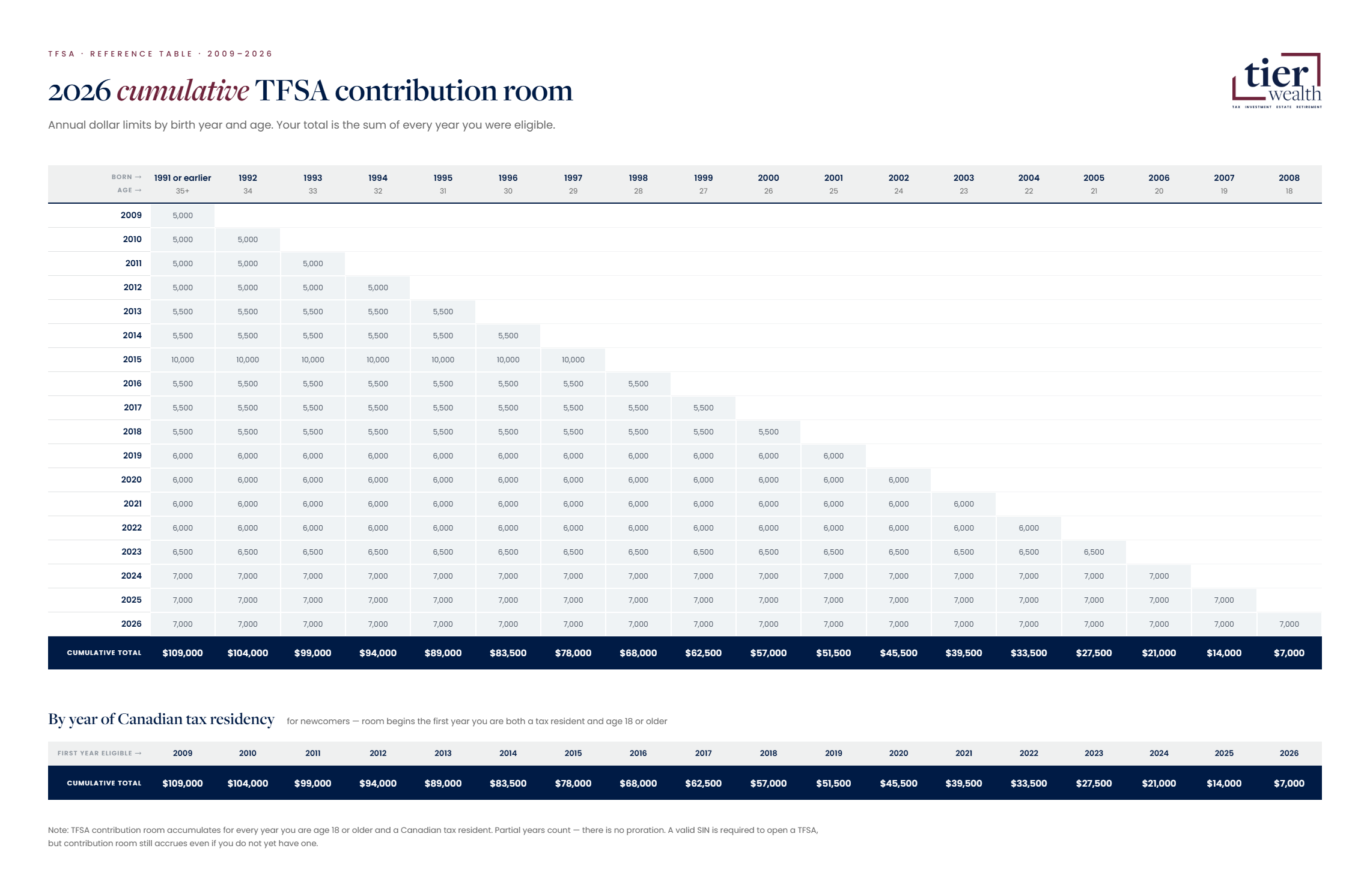
For the spreadsheet-inclined: here's the complete year-by-year reference table — every annual limit from 2009 through 2026, by birth year and by first year of Canadian tax residency, in one place.
The bottom line
The TFSA is one of the most powerful planning tools available to Canadians — but only if you're working from your number, not the headline number. Whether you're a recent graduate just starting to accumulate room, a newcomer building a life in Canada, or a parent helping a newly-18 child open their first account, the starting point is the same: figure out your actual cumulative room before a single dollar goes in.
