
By TIER Wealth
It is common to see the OAS clawback described as a 15% tax stacked on top of your marginal rate. Here are a few examples from this year:
“That's effectively an extra 15% tax on top of your marginal rate.”
“Every extra dollar you earn over the threshold gets hit with normal income taxes and costs you an extra 15% in lost benefits.”
“For a retiree with a marginal tax rate of about 40%, the clawback can push this to roughly 55%.”
Sources
Example 1, “RRSP Early Meltdown Strategy: Maximize Retirement Income in Canada”, updated September 15, 2026.
Example 2, “OAS clawback 2026 explained: Income limits & how to avoid losing your benefits”, June 25, 2026.
Example 3, “OAS clawback: how Canada’s retirement income recovery tax works — and how to reduce it”, August 2026.
It is one of the most widely repeated descriptions of the clawback, and we felt it was important to clear up this common misunderstanding. The 15% is real, but it is not the full story.
The headline: a 15% surtax on top of your tax rate
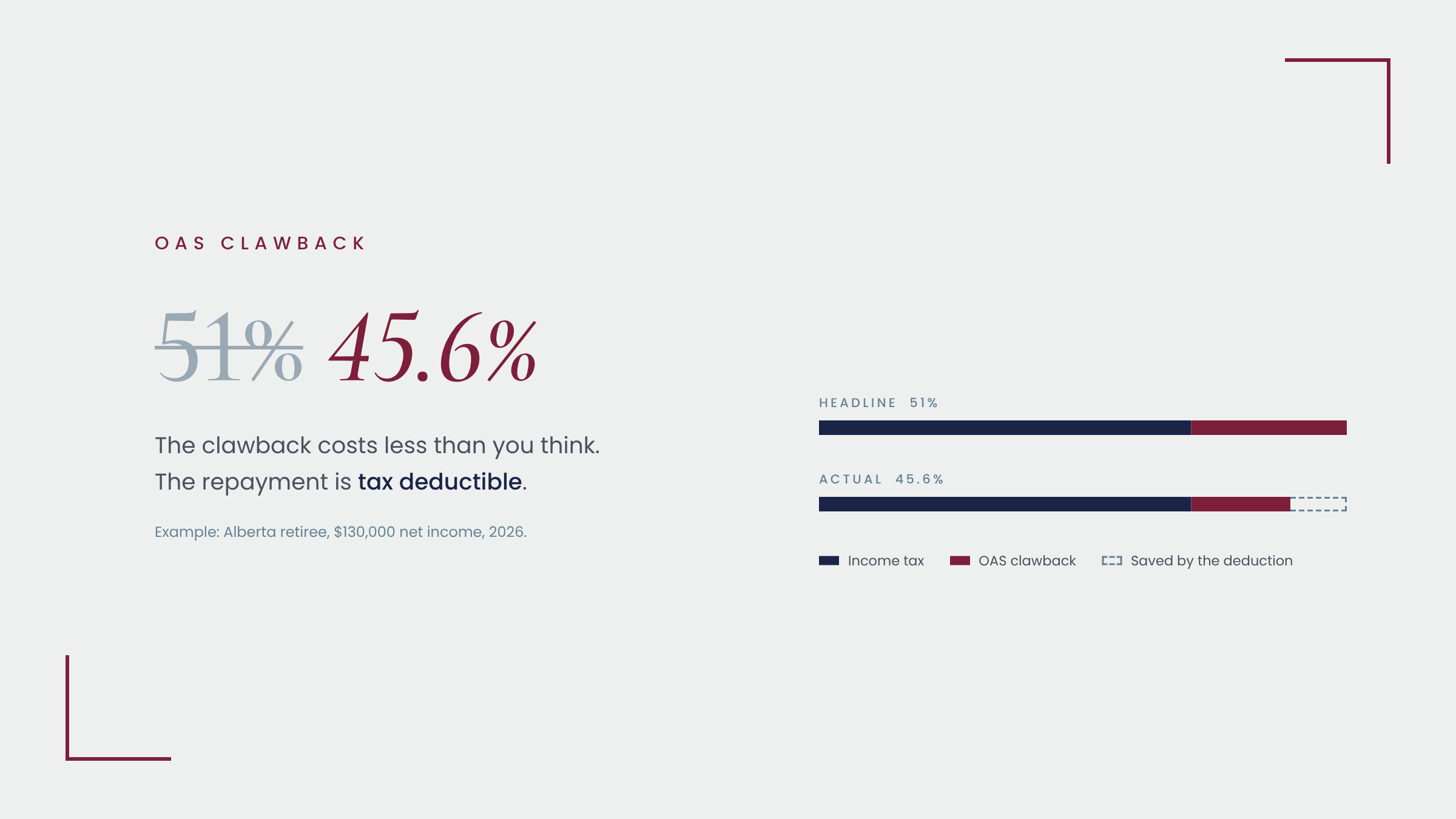
Once your net income (line 23400) passes $95,323 in 2026 ($97,801 in 2027*), the government recovers 15¢ of your Old Age Security for every dollar above that line, until the whole pension has been repaid at about $155,320 (age 65–74) or $161,320 (age 75+). These ceilings assume OAS starts at 65. Deferring OAS raises the pension by 0.6% for each month of deferral, up to 36% at 70, so more of it is left to claw back and the ceiling is higher: about $176,919 (age 70–74) for someone who deferred to 70. It is usually described as a 15% tax stacked on top of your regular marginal rate. Take an Alberta retiree with $130,000 of net income in 2026. Their combined marginal rate is 36% (26% federal + 10% Alberta), so the usual description puts the rate on their next dollar at 51%.
* 2027 amounts in this article are TIER Wealth projections based on the 2.6% statutory indexation factor, pending CRA publication.
What the headlines miss: the repayment is deductible
The OAS you repay is deducted on your return (line 23500) before your taxable income is worked out, and that deduction saves tax at your marginal rate. Every 15¢ of OAS you repay cuts your income tax by 15¢ × your marginal rate. So the net cost of the clawback is 15% × (1 − your marginal rate), not a full 15%, and the higher your tax bracket, the less the clawback adds on top.
Net cost of the OAS clawback
15% × (1 − your marginal tax rate)
In this article, the “true rate” means your ordinary marginal tax rate plus the net cost of the OAS clawback. It does not include other income-tested credits and benefits, which can add to the rate for some people (see the age amount below).
A worked example
Our Alberta retiree, at $130,000 of net income and a 36% marginal rate, earns $1,000 more.
| Headline view | Actual | Difference | |
|---|---|---|---|
| Extra income earned | 1,000 | 1,000 | – |
| Income tax on it at a 36% marginal rate | 360 | 360 | – |
| OAS repaid (15% of the extra income) | 150 | 150 | – |
| Less: tax saved by deducting the OAS repaid (line 23500) | – | (54) | (54) |
| Net cost of the clawback (actual: 15% × (1 − 36%)) | 150 | 96 | (54) |
| Total cost of the extra income (income tax + net clawback) | 510 | 456 | (54) |
| Effective rate on the extra income | 51.0% | 45.6% | (5.4%) |
What the clawback really costs at each marginal rate
| Your marginal tax rate | OAS repaid per $1 | Less: tax saved by the deduction | Net cost of the clawback | Income tax on the $1 | Headline (rate + 15%) | True rate (rate + net cost) | Overstated by |
|---|---|---|---|---|---|---|---|
| 27.5% | $0.150 | ($0.041) | $0.109 | $0.275 | 42.5% | 38.4% | 4.1% |
| 30.0% | $0.150 | ($0.045) | $0.105 | $0.300 | 45.0% | 40.5% | 4.5% |
| 32.5% | $0.150 | ($0.049) | $0.101 | $0.325 | 47.5% | 42.6% | 4.9% |
| 35.0% | $0.150 | ($0.053) | $0.098 | $0.350 | 50.0% | 44.8% | 5.3% |
| 37.5% | $0.150 | ($0.056) | $0.094 | $0.375 | 52.5% | 46.9% | 5.6% |
| 40.0% | $0.150 | ($0.060) | $0.090 | $0.400 | 55.0% | 49.0% | 6.0% |
| 42.5% | $0.150 | ($0.064) | $0.086 | $0.425 | 57.5% | 51.1% | 6.4% |
| 45.0% | $0.150 | ($0.068) | $0.083 | $0.450 | 60.0% | 53.3% | 6.8% |
| 47.5% | $0.150 | ($0.071) | $0.079 | $0.475 | 62.5% | 55.4% | 7.1% |
| 50.0% | $0.150 | ($0.075) | $0.075 | $0.500 | 65.0% | 57.5% | 7.5% |
| 50.3% | $0.150 | ($0.075) | $0.075 | $0.503 | 65.3% | 57.8% | 7.5% |
First row: the lowest combined federal + provincial rate at the $95,323 threshold in any province or territory (NU). Last row: the highest rate below $250,000 in any province or territory (NS). OAS started at 65 is fully repaid by $155,320, where the highest rate in any province or territory is 47.5%; the rows above that show what the clawback would cost at a higher rate. Per $1 of regular income (pension, RRIF, interest). The published OAS recovery ceilings assume a standard year of maximum pension payments. Higher ceilings can arise where a larger pension is payable because of deferral, or where accumulated retroactive benefits are received in one tax year.
Cost of the next $1 of income in the clawback range
Each line plots the formula across the range of marginal rates in the table above. The chart opens at the 36% Alberta example; hover or tap to read the headline and true rate at any other rate.
Interest, eligible dividends and capital gains
The 15% clawback applies to net income, and each type of income adds a different amount to net income per dollar received. Interest adds the full dollar. An eligible dividend is grossed up by 38%, so each $1 received adds $1.38. Only half of a capital gain is included, so each $1 adds $0.50. The deduction for the OAS repaid works the same way for all three: it saves tax at your marginal rate on ordinary income.
Using the same Alberta example, here is what $1 more of each would cost at the 36% bracket.
| Per $1 received | Interest | Eligible dividends | Capital gains |
|---|---|---|---|
| Added to net income | $1.000 | $1.380 | $0.500 |
| Income tax on the $1 | $0.360 | $0.178 | $0.180 |
| OAS repaid (15% of the net income added) | $0.150 | $0.207 | $0.075 |
| Less: tax saved by deducting the OAS repaid (at 36%) | ($0.054) | ($0.075) | ($0.027) |
| Net cost of the clawback | $0.096 | $0.132 | $0.048 |
| Total cost of the $1 (income tax + net clawback) | $0.456 | $0.310 | $0.228 |
| Headline view (income tax + full 15% clawback) | 51.0% | 38.5% | 25.5% |
| True rate | 45.6% | 31.0% | 22.8% |
| Overstated by | 5.4% | 7.5% | 2.7% |
Alberta combined federal + provincial rates at the 36% bracket: 36.00% on interest, 17.75% on eligible dividends, 18.00% on capital gains. Assumes net income stays inside the clawback range.
Eligible dividends trigger the most clawback per dollar received, because of the gross-up, even though the dividend tax credit keeps the income tax on them low. They are also where the headline view is furthest off, at 7.5 percentage points, because a larger clawback means a larger deduction. Capital gains trigger the least, because only half of the gain counts toward net income.
Near the threshold: the age amount
One overlap to watch near the threshold: the federal age amount ($9,208 in 2026; $9,448 in 2027) is reduced by 15% of net income above $46,432 ($47,639 in 2027) and is fully eliminated at $107,819 ($110,626 in 2027).
That reduction is based on net income after the OAS repayment is deducted (line 23600), so the age amount is not gone until income before the repayment (line 23400) reaches about $110,024 (about $112,889 in 2027).
In that band, each extra dollar of ordinary income adds $0.85 to net income, which reduces the age amount by about 12.75¢ and raises federal tax by approximately 1.8¢. That adds about 1.8 percentage points to the effective marginal rate (approximately 1.5 points for Quebec residents, after the federal Quebec abatement).
In all nine provinces outside Quebec, the ordinary provincial age amount has already been fully phased out before OAS recovery begins. Quebec instead combines its age, eligible retirement-income and living-alone amounts into a single credit that is reduced based on family net income. Depending on the amounts available to each spouse, this combined credit can remain in play during the OAS recovery range. The three territories are also exceptions: their age amounts continue into the recovery range, potentially increasing the effective marginal rate further.
The takeaway
Across every province and territory, the true cost of an additional dollar of ordinary income while the clawback applies runs from about 38.4% to 57.8%, not the 42.5% to 65.3% the headlines from many publications suggest.
These figures isolate the OAS clawback. Other income-tested credits and benefits, such as the age amount above, can add to the rate for some people.
The higher your bracket, the more the deduction is worth, so the gap widens to 7.5 percentage points at the top. The clawback is still a real cost, and keeping income below the threshold (pension income splitting, drawing RRSP or RRIF money before 65, favouring the TFSA, timing capital gains) is still worthwhile. But when weighing a choice such as an extra RRIF withdrawal or deferring OAS, use the true rate, not the headline.
Illustrative. Marginal rates are combined federal + provincial rates. Applies to regular income such as pension, RRIF withdrawals and interest while net income is inside the clawback range. The worked examples use an Alberta resident with $130,000 of net income; dividends and capital gains are shown at Alberta rates. GIS, provincial seniors’ benefits and other income-tested credits are not included. Although the author is an employee of Q Wealth and/or an employee of a partner firm of the Q Wealth Partnership, this is not an official Q Wealth publication, and the views expressed herein are those of the author alone, and they have not been approved by, and are not necessarily those of, Q Wealth. This is not legal, accounting, tax or investment advice and should not be relied on as such.
Know your true rate
TIER Wealth has recently revamped its client review meeting package. It now shows your full effective marginal rate, including the OAS clawback and the other income-tested credits and benefits that apply to you. You see what the next dollar you earn will actually cost you, and what the next dollar of deduction will actually save. No rules of thumb, just real tax information tailored to your exact situation. That is another way we add value for our clients.
